

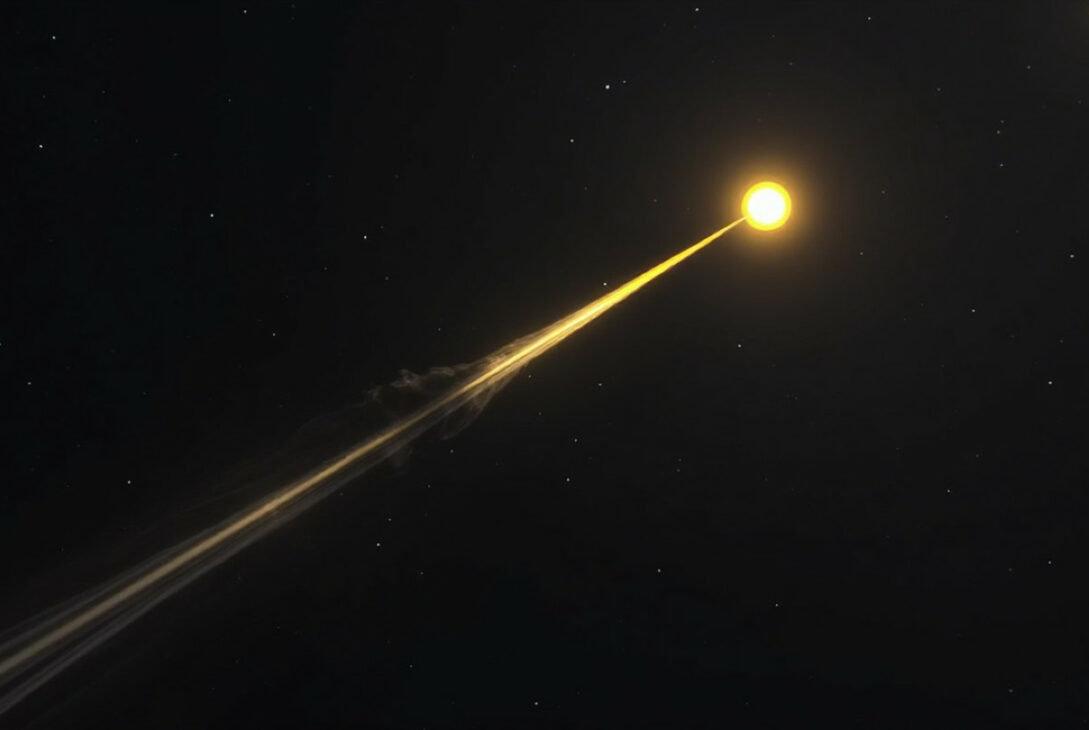
Find out why this interstellar object is driving scientists crazy.
Have you ever wondered what would happen if a messenger from another solar system knocked on our door? I’m not talking about spaceships or little green men, but something even more fascinating: a comet carrying the secrets of a distant world, with a chemical composition so strange it has scientists shouting, “What on earth is that?”
Welcome to the story of Atlas, comet 3I/2025 (that’s its official name, but let’s just call it Atlas to keep things simple). It’s only the third interstellar visitor ever confirmed in human history, and trust me when I say it’s the one making the most noise. But not for the reasons you might think.
Why is everyone talking about this comet?
Let’s take a step back. If you’re reading about Atlas for the first time, you’re probably wondering what’s so special about a piece of dirty ice wandering through space. Well, get ready, because the answer is: pretty much everything.

In early July 2025, the Atlas Observatory in Chile spotted something unusual in the sky. At first glance, it looked like any other comet: a faint, blurry dot with just a hint of activity. But when astronomers crunched the numbers, they didn’t add up at all.
Its orbit wasn’t elliptical like normal comets that circle the Sun. It was hyperbolic. In plain English? This comet wasn’t taking a sightseeing tour of our solar system. It was just passing through in a hurry, like someone driving through your town on the highway without even stopping for a coffee.
It was moving at about 221,000 km/h (that’s 137,000 miles per hour for those who prefer). That’s so fast it could travel from Earth to the Moon in less than two hours. At that speed, it was clear it didn’t come from around here. It wasn’t trapped by the Sun’s gravity. It was an interstellar visitor, an object from another star system.
A very exclusive club
Now, interstellar visitors are rare. Incredibly rare. Before Atlas, we had only confirmed two:
Oumuamua (2017): A strangely shaped rock that zipped away without developing a tail, sparking endless debates about what it actually was. Some even speculated it might be artificial (spoiler: probably not).
Borisov (2019): It behaved more like a normal comet, but it still had that “interstellar passport” that made it special.
And now Atlas. The third member of the club. Three in total out of billions of comets and asteroids we know of. These are discoveries that literally happen once in a generation.
The first clues: something’s weird here
When scientists analyzed the initial data, they found that Atlas’s nucleus is between 0.5 and 2 kilometers in diameter. Small but mighty, enough to power a spectacular coma (the cloud of gas surrounding the nucleus) and a tail as it streaks through space.
At the time of discovery, Atlas was still very far away, more than three times further from the Sun than Earth. But even from that distance, it was already showing signs of activity. There was a faint coma of gas and dust, a clue that sunlight was already warming its icy surface and starting to release material.
That first look was enough to get scientists excited. If it was already “waking up” at that distance, what would it look like as it got closer to the Sun? And more importantly, what would it reveal about its chemical makeup?
The transformation: when a smudge becomes spectacular
Fast forward a few months. Since that first discovery, astronomers worldwide have kept a close eye on this comet. And the Gemini South telescope in Chile captured new images in late August showing dramatic changes.
The coma had become much brighter. The tail had visibly lengthened. It was no longer just a blurry smudge: you could actually see it taking on the classic look of a comet. This change meant it was losing more and more material as it heated up, releasing gas and dust at a much faster rate.
In other words, it was coming to life before our eyes.
The mystery of the green glow
Then something even more intriguing happened. Some observers started noticing traces of a greenish glow in the comet’s coma. Now, if you’ve followed comets before, you know this isn’t necessarily unusual. Comets sometimes turn green when molecules like diatomic carbon or cyanogen are excited by sunlight and start leaking out.
But the possibility of Atlas glowing green so far from the Sun got people talking. Could it be carrying an unusually large amount of these molecules? Or was it just starting to release them earlier than expected? Astronomers are still cautious about confirming the final color, but even the suggestion reinforces the feeling that this comet isn’t following the usual script.
Asymmetric activity: a nucleus full of surprises
There’s another interesting detail. The comet’s activity isn’t symmetrical. Observations show it’s losing more material on the side facing the Sun than on the shaded side. This might seem obvious (after all, the Sun is what’s heating it), but the disparity is much more marked than normal.
This suggests the nucleus isn’t uniform. Maybe one part of it is richer in volatile substances, or maybe the structure itself makes it easier for gas to escape in certain areas. Either way, it’s giving scientists a front-row seat to observe how an alien comet behaves under solar heat.
James Webb enters the scene: the real revelation
So, the visual appearance has changed a lot. A brighter coma, a longer tail, a possible green glow, and asymmetric activity. But that’s just what ground-based telescopes could see. The real breakthrough came when astronomers pointed the James Webb Space Telescope at Atlas.
Because while ground images show us what the comet looks like, Webb can tell us what it’s actually made of. And this is where the story takes a sharp and completely unexpected turn.
On August 6, 2025, the JWST pointed its powerful eye toward the comet using its near-infrared spectrograph. It might sound technical, but the idea is simple: this instrument doesn’t just take photos. It breaks down the comet’s light into its different wavelengths, a bit like a prism diffracting white light into a rainbow.
And hidden in that rainbow are the chemical fingerprints. Every molecule—water, carbon dioxide, methane—leaves a unique mark. When Webb reads the light from a comet, it’s essentially scanning a barcode of everything evaporating from its surface.
The amazing thing? It works even from millions of miles away. We don’t have to send a spacecraft up there, we don’t have to scrape off some ice and bring it back. Webb can tell us the recipe just by looking at the light.
The shock discovery: this comet is completely upside down
So, what did Webb see? Scientists expected to find the usual mix: lots of water vapor, maybe a bit of carbon dioxide and carbon monoxide, along with dust and ice grains. That’s the standard signature of comets in our solar system.

But Atlas had no intention of following the rules.
The data shocked even the most seasoned comet experts. Instead of the water that usually dominates comet composition, Atlas was pumping out carbon dioxide. And not in small amounts. The ratio of carbon dioxide to water vapor was about 8 to 1.
Let me repeat that because it’s really important: for every molecule of water, there were eight molecules of carbon dioxide. Most comets in our solar system have the opposite ratio, with much more water than CO2.
To put it simply: the chemical composition of this comet is completely upside down compared to what we expect.
Why is this difference so important?
This discovery raises fascinating questions. Did Atlas form in a region of its home system so cold that carbon dioxide could freeze and accumulate, while water remained trapped in different forms? Or is the comet’s surface somehow sealed, letting CO2 escape more easily while water stays trapped until it gets much closer to the Sun?

Both hypotheses are possible. But either way, it means this comet holds a story about the conditions of another star system very different from our own.
Think about it for a second. Every comet we study from our “backyard” tells us about the early days of the solar system, what the disk of gas and dust around the young Sun was like. But Atlas doesn’t come from here. Its frozen chemistry is a sample from another stellar nursery, shaped by completely different temperatures and chemical conditions.
Looking at it is like holding a rock from another planet, except the origin of this one is even more distant and uncertain.
Not just CO2: a complex chemical cocktail
Carbon dioxide isn’t the only thing Webb spotted. Mixed in with the outgassing were water (yes, it’s there, it’s just not the main ingredient), carbon monoxide, a sulfur-containing molecule called OCS (carbonyl sulfide), and plenty of dust and ice.

It’s like expecting a glass filled mostly with water and finding out it’s mostly soda with just a splash of water mixed in. Completely the opposite of what you’d expect.
The mysterious dust: when even the grains don’t behave normally
But wait, there’s more. Besides the bizarre chemistry, there’s another aspect of Atlas that has left scientists puzzled: its dust.
Astronomers used a technique called polarimetry to study how light reflects off dust particles in the coma. While the name sounds technical, the idea is simple: when light reflects or scatters off tiny particles, it changes in ways that can reveal the size, shape, and texture of those particles.

And Atlas’s dust “handshake” was completely unexpected. The comet showed what’s called an “extremely negative polarization branch at small angles.” In simple terms, the way its dust reflected light was strangely different, more unusual than anything ever seen from comets in our solar system.
In fact, the effect was stronger than anything seen before, with a drop in polarization of less than 2%. Comets normally follow certain predictable patterns. Atlas broke that pattern.
This suggests the dust particles have a different shape, are clumped together in an unusual way, or are made of a mix of materials we don’t typically see in local comets. Some astronomers think it could be because the grains are darker, perhaps coated in complex carbon compounds.
When even the dust—the simplest ingredient—behaves so strangely, astronomers are forced to rethink the very meaning of “normal” when it comes to comets.
The three interstellar musketeers: comparing the visitors
Now that we have three confirmed interstellar visitors, it’s worth comparing them to see how different they are from each other.
Oumuamua appeared out of nowhere, moving so fast that astronomers barely had time to spot it before it disappeared. The weirdest thing? It never developed a tail. It didn’t look like a comet; it behaved more like a piece of rock. And then there was that strange acceleration as it left, as if something gave it a little push. It broke all the rules and drove scientists crazy.
Borisov was easier to understand. From the start, it looked and behaved like a normal comet. It had a clear coma, a long tail, and its chemical composition wasn’t much different from the comets we see here. The main difference was simply that it didn’t come from here. It reassured us that other solar systems produce comets similar to ours.
Atlas is something in between. At first glance, it’s clearly a comet, no doubt about it. But once you look closer, especially with the JWST, you see it doesn’t match either of the first two. It’s not a bare rock like Oumuamua, and it’s not a “normal” comet like Borisov. It’s a comet with a chemical composition so unusual it forces us to stop and think.
But is it alien? (In the technological extraterrestrial sense)
Whenever an interstellar object appears, headlines tend to lean quickly in one direction: “Could it be an alien object?”. We saw it with Oumuamua, and as expected, Atlas has sparked speculation too.

Famous Harvard astrophysicist Avi Loeb even proposed a framework called the “Loeb Scale” to evaluate whether interstellar objects like Atlas might be alien technology. This scale goes from 0 (definitely natural) to 10 (definitely artificial). For Atlas, Loeb gives a score of 2 to 3, citing its potentially massive size and precise orbit.
But here’s the thing: there are no clear signs of alien technology. No radio signals. No sharp edges. No deliberate maneuvers. Just a natural object behaving in a way that makes us rethink the variety of comets existing in the universe.
And honestly? The natural explanation is the most exciting one. If a comet from another system is this unusual, it means there could be countless others out there, each with different chemical fingerprints. It’s like receiving postcards from places we can’t visit, snapshots of alien star systems delivered right to our cosmic neighborhood.
You don’t need science fiction to make this compelling. The science itself is more than enough.
What will happen in the coming months?
Atlas hasn’t reached its peak moment yet. Its closest point to the Sun (called perihelion) won’t happen until late October 2025. At that point, it will be about 1.36 astronomical units away—a bit further than Earth, but close enough for sunlight to heat it significantly.
And when that happens, we’ll get to see how it behaves under more intense conditions. Will carbon dioxide continue to dominate, or will water eventually become the main driver of activity? That’s one of the big questions researchers are waiting to answer.

After perihelion, the comet will pass Earth’s orbit in December at a huge distance (nearly twice the distance between the Sun and Earth), so there’s no danger to us. But it’s close enough to be observed by telescopes worldwide. And maybe, just maybe, even amateur astronomers with good gear might be able to spot it.
Don’t expect a blazing comet streaking across the night sky like in ancient paintings. But if activity keeps increasing, it could become bright enough to be visible with decent optics.
A once-in-a-lifetime opportunity
Here’s the part that makes this even more special: this is a one-shot deal. Atlas is on a hyperbolic trajectory. Once it passes, it’s gone for good. It will never come back. We’ll never get another chance to study it.
That’s why scientists are pouring all their energy into observing it right now. Every spectrum, every image, every bit of data is precious. It’s not just about this comet; it’s about what this icy traveler can teach us about star systems we’ll never visit in person.
As Atlas continues its journey through our solar system before returning to wander in the interstellar darkness, it leaves us with an important lesson: the universe is much more diverse than we ever imagined.
Our solar system isn’t the blueprint for everything that exists out there. It’s just one example among countless others, each with its own quirks, chemical conditions, and stories to tell.
Every interstellar visitor we spot is like a letter in a cosmic bottle, a message from worlds we may never visit. And that letter tells us: “Hey, look how different we are. Look at how many variations exist in the universe.”
You don’t need grey aliens with big eyes and shiny spaceships to make space fascinating. You just need the curiosity to look closely at what the universe sends our way, the patience to study it with the scientific method, and the humility to accept that there’s still so much to learn.
Atlas is teaching us that every time we think we’ve figured out how comets work, the universe sends us a reminder: “You haven’t seen anything yet.”
And frankly? I can’t wait to see what the fourth interstellar visitor sends our way. Because if three objects can be so incredibly different, who knows what other surprises are waiting for us out there in the depths of space, ready to knock on our cosmic door.
Science really is stranger and more wonderful than any sci-fi story. And Atlas is living proof… or rather, frozen proof.


