


Between ancient astronauts, failed apocalypses, and the irresistible pull of impossible theories: a journey into the myth that never dies.
Have you ever heard of Nibiru? Maybe during one of those late-night conversations that start with, “What if aliens really exist?” and end at three in the morning somewhere between conspiracy theories, X-Files quotes, and references to that documentary you watched on YouTube. Or maybe you came across the name while scrolling through Reddit, lost in r/conspiracy threads, or while playing a video game where ancient civilizations hide cosmic secrets.
Well, here’s the thing: Nibiru isn’t just another conspiracy theory to scroll past with a sarcastic smile. It’s much more than that. It’s a cultural phenomenon, a modern myth that has traveled through decades of nerd culture, blending pseudoscience, fantasy archaeology, and a healthy dose of fascination with the unknown. And today I want to take you on that journey—through stars that don’t exist, reinterpreted Sumerian gods, and apocalypses that never happened.
Ready? Buckle up, because we’re about to enter orbit around the most controversial planet you’ve never seen.
The birth of a myth: who was Zecharia Sitchin?
To understand Nibiru, you first need to know its modern prophet: Zecharia Sitchin. Born in Azerbaijan in 1920 and raised in Palestine, Sitchin was a writer with an intense passion for ancient Mesopotamian civilizations. Between the 1970s and the 1990s, he published a series of books known as The Earth Chronicles, in which he developed a theory as fascinating as it was controversial: the gods of ancient Mesopotamia were not mythological deities, but actual extraterrestrials in the flesh.

According to Sitchin’s reconstruction, the Anunnaki—a Sumerian term he interpreted as “those who from heaven came to Earth”—were inhabitants of a mysterious planet called Nibiru. This celestial body, he claimed, followed such an extreme elliptical orbit that it crossed our solar system only once every 3,600 years. Like a giant comet, except habitable and full of technologically advanced aliens.
And here’s where it gets wild: Sitchin claimed these Anunnaki arrived on Earth around 450,000 years ago with a very specific purpose. They needed gold—yes, literal gold—to repair their planet’s atmosphere. But since mining was hard work, they decided to create custom workers. How? By genetically modifying our ancestors, Homo erectus, to produce Homo sapiens.
According to this theory, then, we are the result of an alien genetic experiment. A species of biologically engineered laborers created to extract gold. If that sounds like the plot of a science fiction movie, you are absolutely right. The problem is that Sitchin presented all of this as historical reality, based on his personal interpretation of Mesopotamian cuneiform texts.
The irresistible appeal of a well-told lie
I have to be honest with you: the first time I heard this theory, part of me thought, “Wow, that would be amazing if it were true.” And that’s exactly where Sitchin’s genius intentional or not lies. He built a narrative that answers deep questions we have all asked at least once.
Why are we here? Who built the pyramids? How did ancient civilizations develop such advanced astronomical knowledge? And above all: are we alone in the universe?
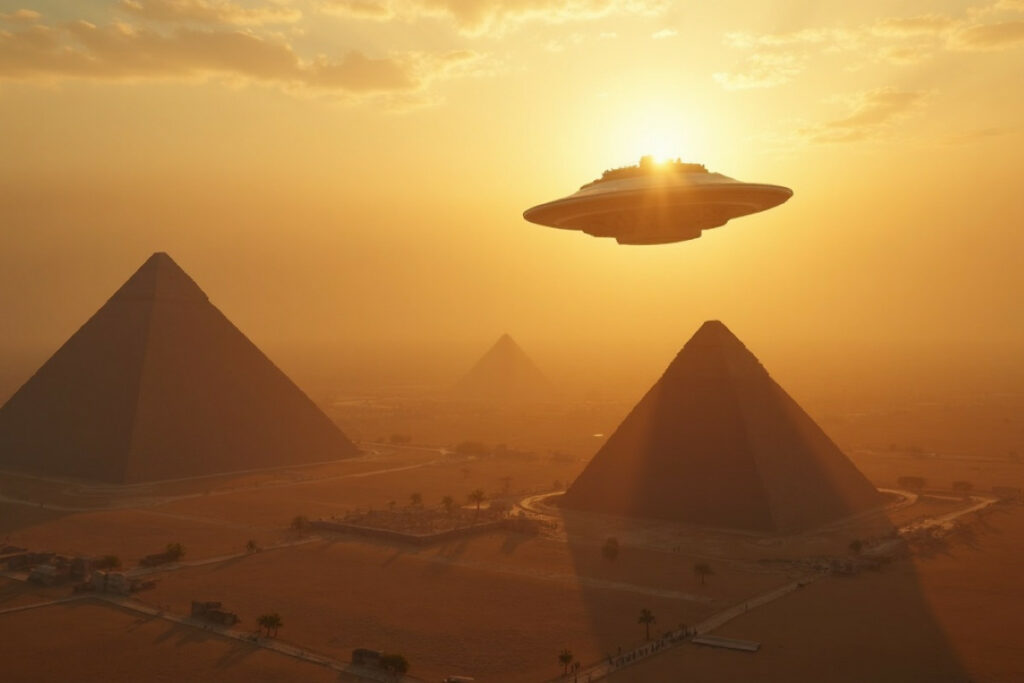
Sitchin’s answer is simple, elegant, and incredibly seductive: we are not alone, we never were, and the proof is written in 5,000-year-old clay tablets if only we knew how to read them properly.
The problem and here we get to the point is that “properly,” according to Sitchin, means “ignoring what the Sumerian texts actually say.” Because real scholars of Sumerian and Akkadian, the people who have dedicated decades of their lives to deciphering those ancient texts, have read the same tablets. And guess what? There is no trace of spaceships, genetic manipulation, or inhabited wandering planets
Assyriologists such as Michael Heiser systematically dismantled Sitchin’s translations, showing that they were based on major errors, forced interpretations, and in some cases complete invention. The word Anunnaki does indeed refer to beings connected to heaven and earth in a mythological sense not an astronautical one. And Nibiru? It was a generic term for a “crossing point” in the sky, associated in different texts with Jupiter, the North Star, or other astrologically significant celestial bodies.
If it’s all false, why are we still talking about it?
Excellent question. And this is where the story becomes culturally fascinating.
Despite its complete lack of scientific foundation, Nibiru did not die under academic criticism. On the contrary, it kept living, evolving, and spreading through popular culture like an indestructible meme. And the reason is simple: Nibiru stopped being just a pseudoscientific theory and became something much more powerful a symbol.
Think of how many ancient astronaut stories you’ve seen in nerd culture. Stargate built an entire franchise on the idea that Egyptian gods were parasitic aliens. Assassin’s Creed based its mythology on a precursor race that created humanity and hid technological artifacts in the past. Ridley Scott’s Prometheus plays directly with the idea of “engineers” who seeded life on Earth. Ancient Aliens on History Channel has run for 18 seasons—yes, eighteen—asking whether every single ancient monument might actually be the work of extraterrestrial visitors.
Nibiru became the perfect archetype for this narrative. It is the mysterious origin, the cyclical return, the cosmic threat, and the promise of revelation all at once. It is the perfect MacGuffin for any story that wants to blend archaeology, cosmology, and a touch of existential paranoia.
2012: when Nibiru was supposed to destroy the world (but forgot)
Se pensavi che Nibiru fosse rimasto confinato ai libri di Sitchin e ai documentari del cable, ti sbagli di grosso. Il vero boom è arrivato nei primi anni 2000, quando la teoria si è fusa con un altro fenomeno culturale: l’apocalisse Maya del 2012.

If you thought Nibiru stayed confined to Sitchin’s books and cable documentaries, think again. Its real explosion came in the early 2000s, when the theory fused with another cultural phenomenon: the 2012 Mayan apocalypse.
But hey, who lets facts get in the way of a good apocalypse?
You probably remember that period. Suddenly everyone was talking about the Mayan calendar “ending” on December 21, 2012, and therefore it had to mean something catastrophic. In reality, the Maya had predicted no end of the world at all; their long-count calendar was simply completing a cycle—like our calendar moving from December 31 to January 1, just on a much larger scale.
But hey, who lets facts get in the way of a good apocalypse?

The internet did the rest. The theory spread virally—before “viral” was even a mainstream word—fueled by YouTube videos, forums, Facebook groups, and an endless stream of clickbait. “SCIENTISTS ARE HIDING THE TRUTH ABOUT NIBIRU!” “NASA KNOWS BUT WON’T TELL YOU!” “LOOK AT THE SKY BEFORE IT’S TOO LATE!”
I remember that era. I remember friends asking me, half joking and half serious, if there might be something to it. I remember the memes, the parodies, but also the people who were genuinely worried. Some stocked up on food. Others planned to flee to the mountains.
And then December 22, 2012 arrived. The sun rose as usual. The Earth kept spinning. Nibiru did not appear. Not even a little.
And then December 22, 2012 arrived. The sun rose as usual. The Earth kept spinning. Nibiru did not appear. Not even a little.
The real science of mysterious planets
Now, I need to make an important clarification here, because I don’t want you to think astronomers are narrow-minded or reject the possibility of unknown planets out of hand. On the contrary, the search for new planets is one of the most exciting frontiers in modern astronomy.
In recent decades we have discovered thousands of exoplanets. We confirmed Pluto, then reclassified it as a dwarf planet. We found Eris, Makemake, Haumea, and other trans-Neptunian objects. And there is indeed a theory about Planet Nine, a hypothetical massive planet in the distant outer solar system that might explain certain orbital anomalies observed in Kuiper Belt objects.
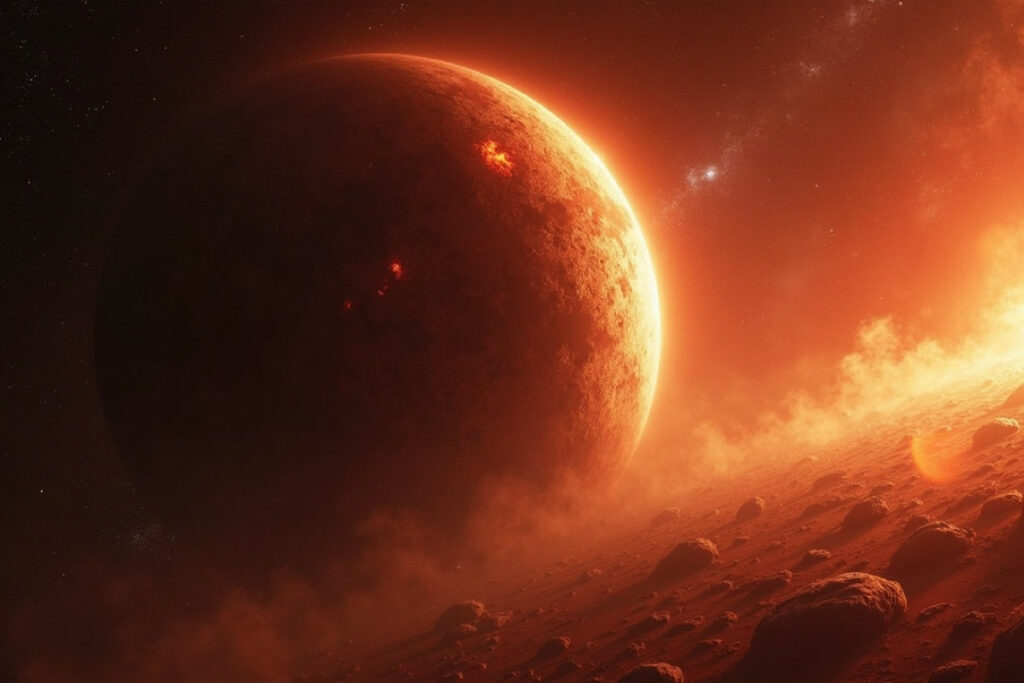
But here is the crucial difference: when astronomers talk about a possible unknown planet, they do so on the basis of observational data, mathematical models, and testable predictions. And most importantly, this hypothetical Planet Nine—if it exists—would orbit at an immense distance, taking 10,000 to 20,000 years to complete one orbit. It would never come close to the inner solar system.
Sitchin’s and Lieder’s Nibiru, by contrast, is impossible for very simple reasons
- It would be visible. A planet four times the size of Earth approaching the inner solar system would shine as brightly as Jupiter or Saturn. You would see it with the naked eye. Millions of amateur astronomers would have photographed it. It would be impossible to hide.
- It would cause orbital chaos. A massive body crossing the inner solar system every 3,600 years would destabilize the orbits of the terrestrial planets. Mars, Earth, and Venus could not have maintained the stable, nearly circular orbits they have had for billions of years.
- It would violate basic physics. The orbit described for Nibiru is astronomically improbable—pun intended. Such an extreme orbit for a planet of that mass would require absurdly specific initial conditions and would be highly unstable over long periods.
As astronomer Phil Plait famously put it: “If Nibiru were real and due to arrive in 2012, by 2009 it would have been the brightest object in the sky after the Sun and the Moon. Where the hell was it?”
Why do we keep loving impossible stories?
And now we come to the real philosophical question behind all this: if Nibiru is so obviously false, why do millions of people around the world still believe it—or at least find it fascinating?
I think the answer lies in human nature itself. We are storytelling animals. Our brains are wired to seek patterns, build connections, and create stories that give meaning to chaos. And when reality feels too mundane, too ordinary, or too unfair, alternative stories become incredibly attractive.

Nibiru parla a quella parte di noi che vuole credere che ci sia di più. Che dietro la facciata di normalità si nasconda una verità segreta, accessibile solo a chi è abbastanza sveglio da vederla. È lo stesso impulso che ci fa amare i film di spionaggio, i romanzi polizieschi, le serie su cospirazioni governative. Ci piace l’idea di essere tra i pochi che “sanno”.
Nibiru speaks to the part of us that wants to believe there is more. Not necessarily aliens. Not necessarily literal flying saucers. But a deeper layer of mystery behind the surface of things. It fascinates us because it combines two powerful forces: the promise of hidden truth and the thrill of cosmic scale.
There is also a rebellious element. Believing in Nibiru means positioning yourself against “the system,” against official science, NASA, governments, institutions. And for many people—especially those who feel marginalized or ignored by mainstream society—that has a certain appeal.
Nibiru in nerd culture: from hoax to icon
And this is exactly where Nibiru found its true home: in nerd culture.
Nibiru fits perfectly into the mindset that loves hidden lore, secret histories, cosmic cycles, and buried truths. It’s like discovering an easter egg in reality—a hidden level in the game of life. Even if we rationally know it isn’t real, playing with the idea has an intrinsic charm.

Look at how many works of pop culture have borrowed—directly or indirectly—from the imagery of Nibiru and ancient astronauts:
- Mass Effect plays with cosmic cycles and progenitor races
- Evangelion blends Kabbalah, Gnosticism, and alternative cosmologies
- The Eternals is built on the idea of ancient visitors who shaped humanity
- indiana Jones has always flirted with esoteric archaeology
- Halo revolves around Precursors and ancient cosmic civilizations
The list could go on forever. Why? Because the archetype works. Narratively, emotionally, aesthetically. Ancient astronauts, lost planets, forgotten secrets—these are powerful tools for telling stories that pull us in.
The lesson of Nibiru: critical thinking in the information age
Alla fine, cosa ci insegna la saga di Nibiru?
So in the end, what does the Nibiru saga teach us?
First, it reminds us how important critical thinking is. In an age when anyone can publish anything online and make it look authoritative, the ability to distinguish reliable sources from nonsense is essential. Sitchin was not a qualified Assyriologist. Nancy Lieder had no scientific credentials. But they presented their theories with enough confidence to convince millions.
Second, it shows how conspiracy theories spread and evolve. Nibiru moved from books in the 1970s, to early internet forums, to YouTube videos, to Facebook groups and TikTok. Every platform gave new life to a fading myth, allowing it to reach new generations.

Third, it teaches us that not everything is black and white. We can appreciate Nibiru as a cultural phenomenon, as a source of narrative inspiration, without believing it is literally real. We can enjoy a film about ancient astronauts while knowing perfectly well it is fiction, just as we enjoy Star Wars without believing the Force exists.
The planet that isn’t there but will live forever
So, after this long journey to the edge of reality and myth: does Nibiru exist?
No. Astronomically, scientifically, no. There is no tenth planet on a collision course with Earth. There are no incoming Anunnaki. NASA is not hiding anything of the sort.
But culturally? Nibiru is more real than many physical objects. It lives in books, documentaries, video games, and online forums. It has become part of our collective imagination—a symbol of our hunger for mystery and our fear of the unknown.
And maybe that is the real power of stories, even false ones. Not their literal truth, but what they reveal about us our fears, our desires, our endless curiosity about the universe around us.
Nibiru will never return, because it was never here in the first place. But as an idea, as a myth, as the starting point for late-night conversations and wild speculation, it will always remain there—quietly orbiting our imagination.


