


A journey through secret bunkers, mysterious skies, and impossible technologies to discover the thin line between myth, fear, and truth
Maybe you, too, at least once in your life, have had that strange feeling while reading a history book or watching a documentary: everything seems clear, linear, and orderly. Dates, battles, people, decisions. And yet… something inside you doesn’t add up. As if a piece were missing. As if someone had decided what you’re allowed to know and what’s better left unsaid.
The story linking Hitler to UFOs starts exactly here. Not from certainty, but from doubt. It doesn’t come from official manuals, but from the questions no one invites you to ask. Have you ever wondered if the documents you know are all that exist? If the archives are truly complete? If the most uncomfortable truths are really being told in full?

When talking about Hitler, the Third Reich, and mysterious technologies, you enter a territory where the line between science, fantasy, propaganda, and secrecy becomes dangerously thin. And the deeper you go, the more you realize that the mystery isn’t just about the past. It’s about the very way reality is constructed before your eyes.
A man obsessed with the idea of surpassing human limits
To understand why this legend found fertile ground, you have to try to get inside Adolf Hitler’s mind—not to justify him, but to understand his obsession. Hitler wasn’t just a power-hungry dictator. He was a man deeply attracted to the idea of transcending the limits of human nature.
Winning battles wasn’t enough for him. Conquering territories wasn’t enough. He wanted to rewrite the rules. He wanted to create a new world, a new man, a new science. The Third Reich invested massive amounts of money and resources into experimental research. Much of this research was so advanced that even today, looking back, it’s quite impressive.
Missiles that reached suborbital space. Jet planes when the rest of the world was still using propellers. Secret labs, underground installations, cities hidden beneath mountains. All of this is documented. It’s not a legend.

Now ask yourself: if they were willing to go that far, how short was the step toward the search for the absolute unknown? When a man no longer recognizes moral limits, he rarely recognizes scientific ones either.
The esoteric side of the Reich: when science and the occult meet
A detail that’s often whispered rather than openly told concerns the relationship between Nazism and occultism. We’re not just talking about myths or folk superstitions. Many men close to power were truly fascinated by the idea that hidden forces, ancient knowledge, and energies beyond human understanding existed.
It’s said that certain groups within the Reich were dedicated to studying archaic texts, astral symbolism, and legends about lost civilizations. According to the alternative narrative, this research wasn’t just spiritual but technical: attempts to understand forgotten or non-terrestrial technologies.

Imagine closed rooms, symbols on the walls, tables piled with star maps, mathematical formulas trying to decipher what doesn’t appear in books. You’re no longer looking at a government. You’re looking at a power cult that wants to force open the doors of the cosmos.
Even if not all of this is historically proven, the idea has taken root because it doesn’t seem entirely crazy. When a power feels absolute, it starts looking for answers even beyond reality.
The sky as a territory of war and mystery
During World War II, many pilots, both Allied and Axis, reported mysterious lights in the sky. Luminous spheres following planes, objects changing direction instantly, glows appearing and disappearing without explanation. These phenomena were called “foo fighters.”
The official version has always spoken of optical illusions, atmospheric phenomena, and combat stress. But the legend has built another possibility. What if those lights weren’t just natural phenomena? What if they were secret tests? Or something even more unsettling?

This is exactly where one of the most fascinating parts of the myth is born: the idea that the Third Reich wasn’t just building weapons, but was trying to dominate the sky in a completely new way.
Circular machines: terrestrial technology or impossible engineering?
One of the pillars of this legend is the alleged disc-shaped aircraft. According to the speculative narrative, the Nazis designed and tested flying machines completely different from traditional planes. No wings. No classic propellers. But circular structures, similar to the UFOs as we imagine them today.

Legend says these aircraft were equipped with unconventional propulsion systems, capable of vertical takeoff and moving in an apparently anti-gravitational way. Now, you might think this is pure science fiction. And it’s right to be skeptical.
But stop and try to ask yourself: if a civilization capable of building ballistic missiles in the 1940s had access to something even more advanced, what would they have called those machines? Maybe exactly what we call them today: UFOs.
The legend of the division that recovered the impossible
The most unsettling part of this whole story is the hypothetical existence of a secret unit with a very specific task: recovering what didn’t belong to Earth.
According to this imaginary narrative, the Reich created special squads ready to intervene whenever something anomalous was reported. Not battlefields. Not enemy bases. But isolated places where something had fallen from the sky.

Picture the scene: dead of night, a silent forest, a sudden glow streaks across the sky, a distant roar. And shortly after, men in dark uniforms cordoning off the area, removing every trace, loading unknown objects onto unmarked vehicles.
All of this lives in the realm of speculation. But it’s a speculation so detailed it feels like a movie someone forgot to film.
Underground labs: science where the sun doesn’t shine
If you’re looking for the place where such research could have taken place, the legend has a clear answer: underground.
Stories speak of complexes hidden in mountains, structures carved into rock, underground cities designed to withstand any attack. Not just bunkers, but actual worlds separated from the surface.

According to the alternative narrative, materials impossible to analyze with conventional science were brought there. Metals that wouldn’t melt. Objects that didn’t reflect light naturally. Devices that seemed to react to human presence.
This is where the legend becomes almost palpable. Not because it’s proven, but because it seems strangely consistent.
Ice as a refuge for secrets
There is one place that, more than any other, represents the concept of total isolation: Antarctica.
According to some speculative theories, the Nazis explored and perhaps colonized a vast glacial area to build an out-of-this-world base. A place where there’s no air traffic. Where there are no cities. Where no one is watching.
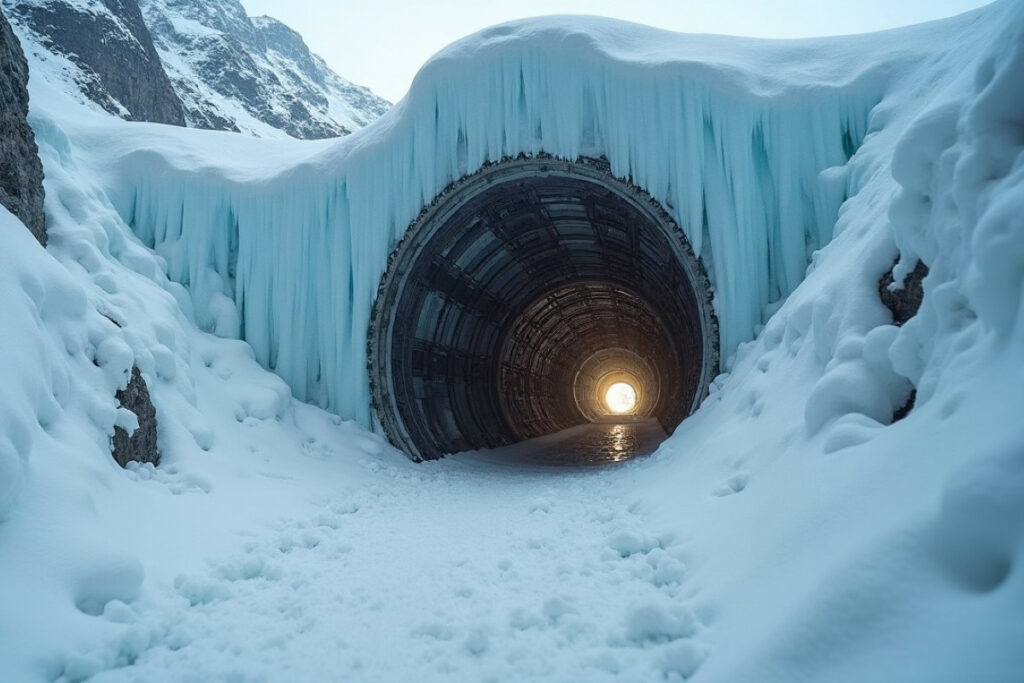
Stories speak of submarines setting sail without complete records, of inexplicable routes, of scientific missions never fully clarified. The ice, in this tale, becomes a perfect curtain. Not just against the world. But against the truth.
The end that perhaps wasn’t an end
The official version tells you that Hitler died in his bunker in Berlin. An almost mundane ending for such a complex and terrible figure. But legends love open questions, and here they find a massive one.
What if that wasn’t the end? What if it was just another version of the facts?
According to the most extreme narratives, Hitler could have relied on escape plans, alternative identities, secret bases, and perhaps even technologies that would have made a perfect disappearance possible.
There is no solid evidence. But the doubt remains. And when doubt remains, the legend survives.
Why this story fascinates you more than you’d like to admit
The truth is, you’re not reading all this by chance. If you’ve made it this far, it’s because a part of you wants to believe there’s more. Not necessarily extraterrestrials. Not necessarily real flying saucers. But a level of mystery that goes beyond the surface.
It fascinates you because it unites two opposing forces: total control and the total unknown. It fascinates you because it challenges the idea that you know everything there is to know. It fascinates you because, deep down, you want to believe the universe is bigger than what you’ve been told.
What if one day everything changed? Close your eyes for a moment and imagine this scenario.
In fifty years, secret archives are opened. Not tabloid newspapers, but government ones. Official documents are published. Photographs. Reports. Technical drawings.
And among those documents, something appears that looks terrifyingly like what you’ve just read.
How would you feel? You probably wouldn’t say “I knew it.” You’d probably feel small. And maybe… fascinated.
The mystery isn’t in the skies; it’s in the questions you keep asking yourself
In the end, Hitler and UFOs are almost a pretext. The real subject isn’t him. It’s not them. It’s you. It’s you asking questions. It’s you not settling. It’s you feeling that reality has invisible cracks. Maybe this legend isn’t true in a historical sense. But it’s true in another sense: it exists because your need for mystery exists. And as long as you keep looking at the night sky wondering if there’s something beyond the stars, these stories will never die.